
Published by Dating Online
Risk often arrives as pressure
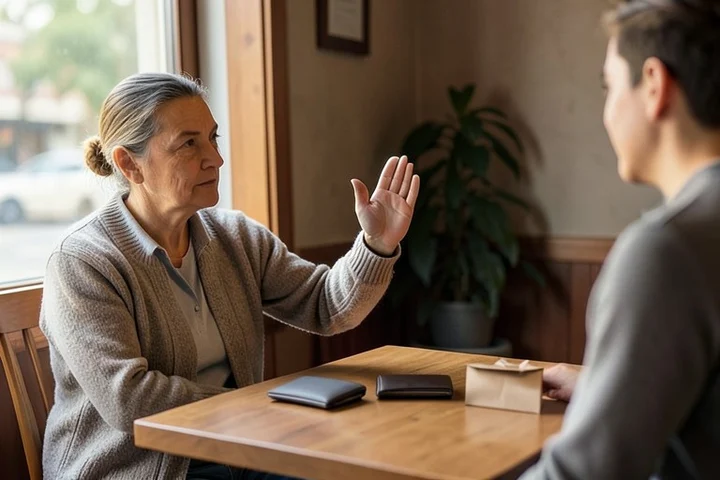
Do not send a match money, cryptocurrency, gift cards, login credentials, bank details, or a verification code. Do not receive or move money for them either. The FTC identifies requests for money or gifts, including cryptocurrency, as a documented romance-scam pattern, and says not to send money or gifts to someone you have not met in person.
A request can be presented as an emergency, a travel problem, a medical expense, an investment opportunity, or a favor needed “just this once.” The story does not change the boundary. End the financial conversation, preserve the relevant messages when safe, and block or report the account.
Slow down when someone demands an immediate answer, insists that you keep the interaction secret, or treats a reasonable boundary as proof that you do not care. Pressure can also appear as a push to leave the app quickly, share a phone number, or continue a conversation through a private channel before you are ready.
These behaviors do not prove that a particular person is deceptive. Agency warnings describe recurring patterns, not a method for deciding a person’s intent. They are still enough to justify a protective action: keep the conversation on-platform, decline the request, or stop contact if the pressure continues.
Verification reduces uncertainty; it does not prove safety
A complete profile, an apparent social-media history, a verification badge, or a video call can reduce some uncertainty. None of those things establishes identity, intentions, or safety by itself. The FTC and FBI warn that romance scams can involve fake online profiles and false identities built to gain trust.
Limited independent checks are most useful for sharpening questions. The FBI advises researching profile photos. If a name, location, work history, photos, or account details do not line up, treat the mismatch as a reason to pause while the explanation remains unverified.
A person may have an ordinary explanation for a discrepancy, and a concerning pattern still requires more evidence before wrongdoing can be established. Public accusations and attempts to investigate someone through their workplace, family, or social network create additional risks.
State the observed fact if you report: “The profile says they live in Chicago, but they repeatedly gave different locations and asked me to buy gift cards.” That is more useful than claiming certainty about who the person is. If they evade basic questions, pressure you to ignore inconsistencies, or ask for money or codes, end contact.
Keep control of your information and your plans
Early messages can remain on the dating app until you are comfortable with the tradeoff of giving someone a direct way to contact you. Financial-account details, passwords, one-time verification codes, a home address, workplace access details, and documents that reveal identifying numbers remain private.
Intimate images require a separate boundary. An image sent because a match says it will prove trust, commitment, or interest may leave your control over where it is stored or shared. A respectful match can accept “I do not share that” without argument.
A first in-person meeting is safest in a setting where you can leave on your own schedule. Independent transportation keeps your arrival and departure under your control. A trusted person should know the meeting location, the planned time, the match’s profile name, and when you expect to check in.
Your phone should remain charged and accessible. A plan change that removes your control, a disregarded boundary, anger about a check-in, or personal discomfort is sufficient reason to leave. There is no need to negotiate your departure or establish that the concern is justified.
Preserve facts before you report
Before blocking, save relevant messages, the profile name and identifying details visible in the app, dates, usernames, phone numbers, payment requests, transaction records, and any links or wallet information involved. Do this only when it is safe; do not prolong contact to gather more evidence.
A useful report separates observations from conclusions. Record what was said, what you sent or received, when it happened, and what account or profile was involved. Saved records can make an app, FTC, or IC3 report easier to review, but they do not require you to prove a crime before reporting.
The dating app’s block and report tools cover suspicious profiles, abusive messages, impersonation concerns, payment requests, and other account or message violations. The app’s current safety center identifies its available report categories and process.
For suspected fraud, the FTC provides the ReportFraud.ftc.gov reporting route. The FBI’s Internet Crime Complaint Center, IC3, provides an online process for internet-crime complaints that fit its submission process. Submit facts and records without overstating what you can know about the other person’s identity or motives.
With immediate physical danger, local emergency services are the appropriate route; an app report or online fraud report cannot replace that response.
What To Know About Romance Scams · Internet Crime Complaint Center · ReportFraud.ftc.gov
Use this continue-or-stop check
- Continue on-platform. This option fits when the conversation is respectful, no one is pressing for personal contact details, money, images, or secrecy, and you are comfortable continuing at your own pace.
- Slow down. This option fits when basic facts do not line up, the person pushes to move off the app, or you feel rushed. Communication can remain on-platform, with no additional personal information shared while explanations remain unverified.
- Block. This option fits when the person persists after a clear no, pressures you for intimate images or private details, ignores meeting boundaries, or asks for money, cryptocurrency, gift cards, credentials, or verification codes.
- Report. The app’s report tool covers account or message violations. Suspected fraud can be reported to the FTC, and an IC3 complaint can be submitted when the matter fits its current criteria. Local emergency services are the route for immediate danger.
Sources for this guide
- What To Know About Romance Scams — Federal Trade Commission
- Internet Crime Complaint Center — Federal Bureau of Investigation
- ReportFraud.ftc.gov — Federal Trade Commission
- Romance Scams — Federal Bureau of Investigation
- Federal Trade Commission (FTC) — official information — Federal Trade Commission (FTC)